Home /
News / Product News / High Temperature vs. Chemical Resistance: How to Choose Filter Media Without Premature Failure
High Temperature vs. Chemical Resistance: How to Choose Filter Media Without Premature Failure
In filter press systems and industrial solid-liquid separation processes, filter media plays a key role in determining filtration accuracy, cycle time, cake moisture content, and overall operational stability. Under high-temperature or highly corrosive conditions, improper material selection can lead to rapid performance degradation or even premature failure—resulting in increased replacement frequency and higher operating costs.
How can you select the appropriate filter media material based on different operating conditions to improve reliability and extend service life?
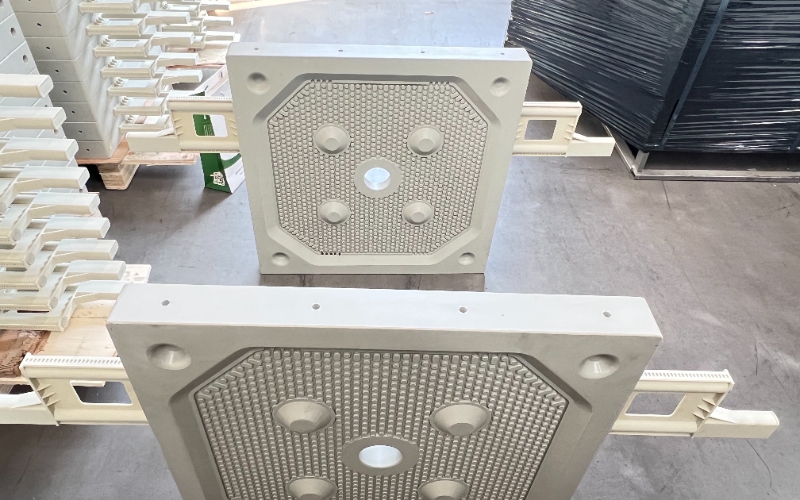
How High Temperature and Corrosive Conditions Affect Filter Media
In practice, high temperature and chemical corrosion often occur simultaneously, causing continuous damage to filter media:
Operating Condition | Key Impact Mechanism | Typical Field Issues |
High temperature (>80°C) | Polymer softening, thermal aging, reduced mechanical strength | Cloth deformation, pore size changes, sealing failure |
Strong acids/alkalis (pH <4 or pH >10) | Molecular degradation, fiber corrosion or swelling | Solids leakage, reduced filtration accuracy, turbid filtrate |
Combined heat + corrosion | Accelerated aging and chemical reactions | Shortened service life, frequent replacement |
These issues are especially common in chemical processing, mining, electroplating wastewater, and fine chemical filtration.
Filter Media Material Selection Strategy
1. Materials for Corrosive Environments
Polypropylene (PP filter cloth)
Suitable for most weak acid and alkali environments (pH 2–12), offering good chemical stability and cost efficiency. Widely used in general wastewater and chemical filtration.Polyester (PET filter cloth)
Provides a balance of moderate chemical resistance and improved temperature resistance, suitable for medium-temperature neutral or mildly corrosive slurries.PTFE filter cloth
Offers exceptional resistance to strong acids, strong alkalis, and high temperatures, making it ideal for extreme operating conditions.
2. Materials for High-Temperature Applications
Glass fiber filter media
Maintains dimensional stability under high temperatures, suitable for hot gas and dust filtration applications.Aramid and composite filter media
Combine heat resistance with mechanical strength, making them suitable for medium- to high-temperature industrial filtration.
Key Selection Principles to Avoid Premature Failure
In real applications, focusing on a single property is not enough. Consider the following:
Match materials to actual operating conditions (temperature, pH, particle characteristics)
Ensure system compatibility:The filter cloth must be used in conjunction with the filter plate assembly to ensure a proper seal and stability. If you encounter any operational issues, please refer to the common issues and solutions for filter plates.
Avoid over-specification in non-critical environments to control costs
Consider long-term operation, including cleaning frequency and pressure control
In practice, Xuda Filtration typically provides customized filter cloth solutions based on specific working conditions, ensuring an optimal balance between performance and service life.
Comparison of Common Filter Media Materials
Material | Max Operating Temperature | Chemical Resistance | Typical Applications |
PP | ≤70°C | Excellent (weak acids/alkalis) | Ambient wastewater treatment |
PET | ≤120°C | Moderate | Medium-temperature slurries |
PTFE | ≤260°C | Excellent(strong acids/alkalis) | High corrosion + high temperature |
Glass Fiber | ≤300°C | Limited (weak acids) | High-temperature gas filtration |
Practical Ways to Extend Filter Media Service Life
Proper system design and maintenance can significantly improve durability:
Perform regular cleaning and maintenance of the filter plates
Prevent clogging and buildup: Select CGR filter plate structures with more stable sealing performance
Choose the appropriate structure type based on operating conditions, such as chamber-type filter plates versus other filter plate types
Control operating parameters appropriately, such as selecting the correct pressure rating for the filter press
These measures help reduce cloth wear, prevent leakage, and improve overall filtration stability.

Conclusion
Under high-temperature or corrosive conditions, the selection of filter media directly impacts system stability and operating costs. By properly matching materials, equipment, and operating parameters, you can significantly reduce replacement frequency and improve efficiency.
For complex or demanding applications, customized solutions are recommended. Xuda Filtration leverages extensive experience in filter plate and cloth integration to deliver reliable filtration solutions across a wide range of industries.
NEED A SAMPLE OR AN OFFICIAL QUOTE?
Contact inquiry@xudaenviro-tech.com for more details.


Related Application